-
Shop
- Adidas
- Advanced Technologies
- AI Skills Mastery 2026 Collection
- Apple Accessories
- Best-Sellers
- Car Accessories
- Dating & Social Confidence
- Dating & Social Skills
- Digital Resources
- Education & Learning
- Family & Parenting
- Fashion
- Fashion Accessories
- Furniture
- Gadgets
- Health & Beauty
- Health & Wellness
- Home & Garden
- Home Supplies
- Kids & Babies
- Kitchen Best-Sellers
- Lighting
- Nike
- Patio, Lawn & Garden
- Personal Growth
- Pet Care
- Pet Supplies
- Pets
- Shoes
- Sport & Outdoors
- Stress Relief & Relaxation
- Summer 2025 Fashion Collection
- Sunglasses
- Super Deals
- Travel
- Travel & Outdoors
- Wealth
- Wealth Building
- Women’s Wellness & Lifestyle
- Popular
- Best deals
1:87 Mini RC Drift Car with Lights, Sound & 2.4G
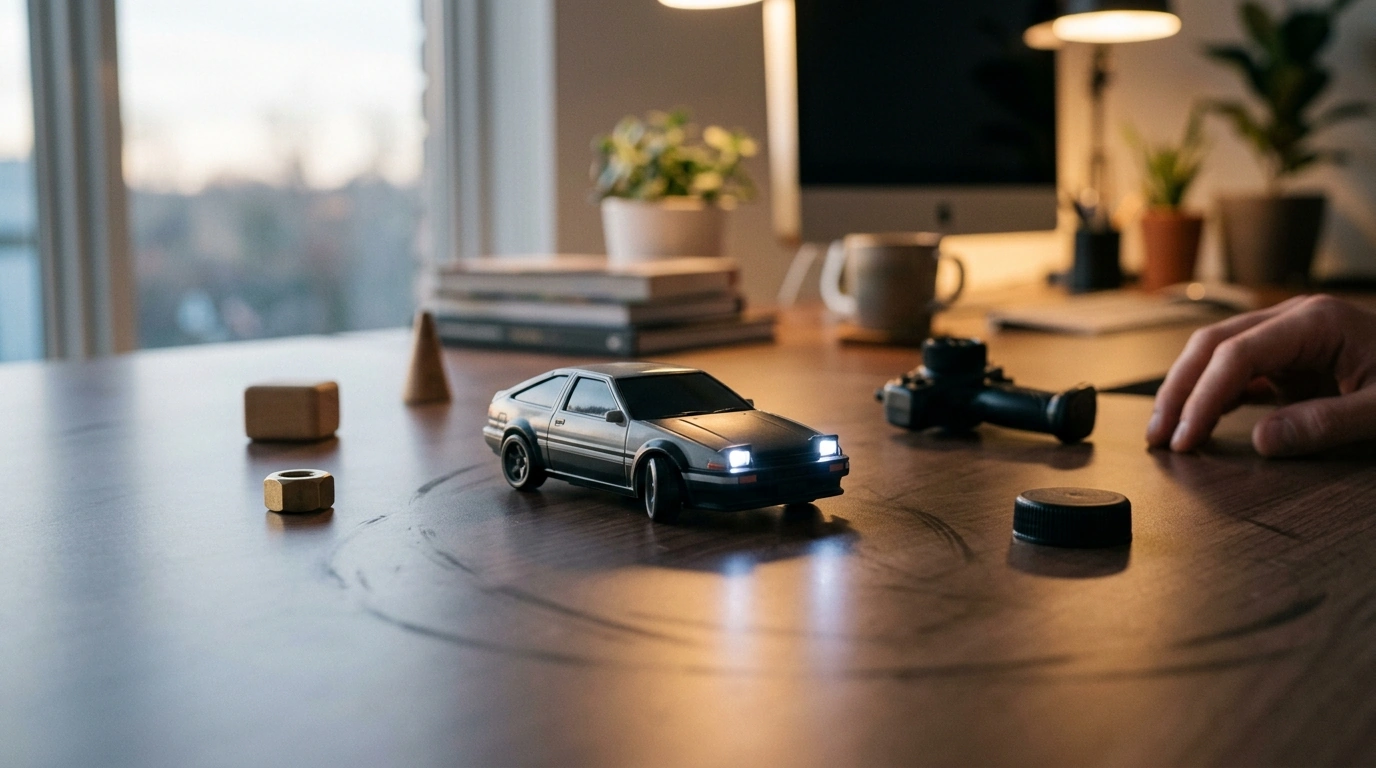
Mini RC Drift Car 1:87 Scale with Lights & Sound – 2.4G Wireless Remote
A tiny drift car that brings the look and feel of parking-lot slides to a desktop-sized scale. With working lights, sound effects, and a 2.4G wireless remote, it’s built for quick setup and smooth, controlled drifting on the right surfaces—ideal for short sessions at home, at the office, or as a gift.
What Makes a 1:87 Drift Car Fun
The best part of a 1:87 drift RC is how much control you can pack into something that fits in your palm. Instead of needing a big track or a wide-open driveway, you can practice steering discipline and throttle finesse in tight indoor spaces.
- Micro scale that fits in the palm of a hand while still offering steering and throttle control
- Drifting focus: encourages controlled oversteer and quick direction changes rather than pure top speed
- Lights and sound add feedback during runs, especially in low-light play areas
- 2.4G wireless control helps reduce interference when multiple RC toys are used nearby
Key Features to Look For
Mini RC drift cars can look similar at a glance, but the experience changes a lot based on control stability, durability, and how “playable” the effects are in everyday rooms.
- Scale and footprint: 1:87 is best for tight indoor spaces and tabletop courses
- Control system: 2.4G wireless for steadier connection and fewer cross-channel issues than older systems
- Lights: useful for visibility and realism; check that they remain visible under room lighting
- Sound: adds immersion; verify whether it can be toggled down/off if quieter play is needed
- Body durability: micro cars benefit from flexible bumpers and a shell that snaps back after light impacts
If you plan to run more than one RC toy at once, 2.4 GHz systems are commonly designed to reduce cross-control. For broader background on compliant wireless devices, the FCC’s equipment authorization resources are a helpful reference: Federal Communications Commission (FCC) — Equipment Authorization.
Quick Setup Checklist
A clean start prevents most first-run frustrations. Take a minute to confirm power, pairing, and basic direction control before attempting drift transitions.
- Charge/insert batteries as required by the car and remote (confirm polarity and compartment closure)
- Power on the remote first, then the car, to help pairing connect cleanly
- Test steering left/right and forward/reverse at low speed before attempting drifts
- Choose a smooth surface (sealed wood, polished tile, smooth laminate) for easier sliding
- Create a simple course with tape lines or small objects as cones to practice consistent angles
How to Get Cleaner Drifts Indoors
Drifting at micro scale is about tiny inputs and timing. Small steering corrections and short throttle pulses often look smoother than holding full throttle and hoping the car catches itself.
- Start with gentle throttle and add steering gradually; abrupt inputs can cause spin-outs at micro scale
- Use short bursts of throttle to break traction, then modulate to hold the slide
- If the car grips too much, switch to a smoother surface; if it slides too much, use slightly more textured flooring
- Practice figure-eights to learn transitions and counter-steer timing
- Keep turns wide at first; tighten the radius as control improves
For households with kids, it’s also worth reviewing general toy safety guidance—especially for small parts and battery handling. Two widely cited resources include CPSC — Toy Safety and ASTM International — Toy Safety Standards Overview (F963).
Mini RC Drift Car Specs at a Glance
This compact drift car is designed for small rooms, desk setups, and quick sessions where you want the satisfaction of sliding corners without a huge footprint.
Product Snapshot
| Item | Details |
|---|---|
| Product | Mini RC Drift Car 1:87 Scale with Lights & Sound – 2.4G Wireless Remote |
| Scale | 1:87 |
| Control | 2.4G wireless remote |
| Effects | Lights and sound |
| Price | $14.51 USD |
| Availability | In stock |
In-Stock Picks (Internal Links)
If you’re ready to add a mini drift setup to your desk or gift list, these items are currently available:
- Mini RC Drift Car 1:87 Scale with Lights & Sound – 2.4G Wireless Remote (In stock)
- 28-Piece Natural Hair Makeup Brush Set (In stock)
- Crime London Men’s White Leather Shoes (In stock)
Care, Storage, and Safety Notes
A micro RC drift car is built for light bumps, but a little care goes a long way—especially around batteries and moisture.
- Let components cool after play before charging or storing (if a rechargeable battery is used)
- Avoid running on wet surfaces; moisture can damage electronics and reduce traction control
- Store the car and remote in a dry place; remove batteries for long-term storage to reduce leakage risk
- Supervise younger children due to small parts and potential choking hazards
- Use only the recommended power source and charging method to reduce battery safety risks
Who It Suits Best
FAQ
Can multiple 2.4G RC cars run at the same time without interference?
Most 2.4 GHz RC systems are designed to pair a transmitter to a specific receiver and manage channels automatically, which helps reduce cross-control compared to older single-frequency toys. Real-world performance can still vary based on distance, battery strength, and the specific transmitter/receiver design.
What surfaces work best for drifting at 1:87 scale?
Smooth indoor surfaces like sealed wood, laminate, and tile usually make it easiest to slide and hold a drift. Rough carpet tends to add too much grip, while extremely slick surfaces can make the car spin out more easily.
Do the lights and sound stay on during driving?
Yes—on models with effects, lights and sound are typically part of the driving experience while the car is powered on. Some versions may include an on/off or volume behavior for the sound, so it’s worth checking the product controls if quieter play is needed.
Recommended for you
Mazda Window Switch Refresh: Metal Button Stickers
Aug 15, 2026
Victoria’s Secret Downfall: What Went Wrong?
Aug 16, 2026













Leave a comment